Showing posts with label China. Show all posts

August 3, 2016

Workshop fosters cooperation and collaboration for group of global forest ecologists

The Center for Tropical Forest Science - Forest Global Earth Observatory (CTFS-ForestGEO) in partnership with the Chinese Forest Biodiversity Monitoring Network (CForBio) held its annual data analysis workshop this month. The workshop is supported by the National Science Foundation (NSF) through the Dimensions of Biodiversity Program and was hosted by the Chinese Academy of Forestry at the Jianfengling 60ha forest plot on Hainan Island in southeast China. The grant, entitled “Dimensions US-China: Integrating the functional, phylogenetic and genetic components of diversity for improved an understanding of forest change and biodiversity” funds annual workshops for graduate students, postdocs, and senior scientists to gather and collaborate on their research and exchange data and ideas.

The group included 65 participants hailing from 20 countries spanning North and South America, Africa, Europe, and Asia. All participants worked diligently and were pleased with the amount of science and training accomplished during the two week workshop.

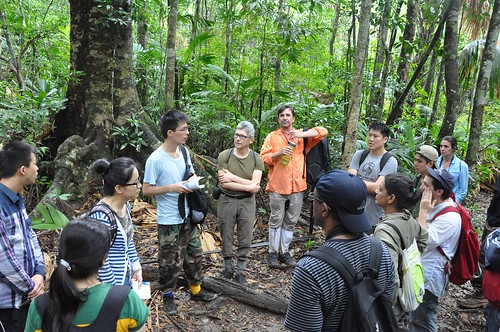
Workshop participants in Hainan, China (photo credit: Yao Tze Leong)
Breakout group on demography related to diversity (Yao Tze Leong)
The workshop mission was to bring together a global network of forest researchers to foster research advances and scientific collaborations. This is carried out though an ongoing collaboration between CTFS – ForestGEO and the CForBio with the Chinese Academy of Sciences. Among 51 plots in the CTFS-ForestGEO and CForBio networks, a vast amount of research is being done on how dimensions of biodiversity are changing in forests. Forests everywhere are under threat from deforestation, pollution, invasive species, degradation, and climate and atmospheric change. Understanding and analyzing the data on tree species functional traits, phylogeny, and genetics from the network will inform predictions of forests’ dynamic responses to anthropogenic change.

Sabrina Russo mentors a breakout group (Yao Tze Leong)
Participants worked tirelessly to curate and analyze the immense amount of data pouring out of the global network. The approach centered around small “break out” groups focused on how the dimensions of forest biodiversity regulate the dynamics of tropical forests around the world. Each group received close hands-on mentoring by senior scientists associated with Smithsonian Institute and CTFS-ForestGEO. Participants were guided through the analyses and writing stages of their projects in order to produce manuscripts intended for submission to a peer-reviewed scientific journal.

Erandathi Ekanayake presents findings to her group (Yao Tze Leong)
This intense work schedule was punctuated by lively group meals, happy hours, and lots of joking and cultural exchange. Each day was bookended by lectures from the postdocs and scientists in attendance. Among the notable mentors this year was Steve Hubbell who gave a lecture on forest diversity. A highlight for many participants was the day trip to the Jianfengling 60 ha forest dynamic plot, which is a tropical submontane rainforest notable for its adaptation to seasonal typhoon disturbances. The 65 researchers all trekked the 5 km through bouts of torrential downpours- a proud testament to the fieldwork experience and fortitude possessed by the participants!

Han Xu leads the field trip to the Jianfengling plot (Yao Tze Leong)
Aaron Hogan takes a dbh measurement during the field trip (Yao Tze Leong)
The workshop culminated in an all-day symposium where each participant gave 5-minute lightning talks about their projects and the progress they had made during the workshop. There is no doubt that dozens of CTFS-ForestGEO manuscripts published this year will be largely thanks to the hard work accomplished in Hainan!  

The friendships and connections fostered among participants made the last day bittersweet, but all agreed to prioritize attending the next annual workshop in the USA. 

2016 Workshop in Hainan, China

August 11, 2011

NSF-Supported Scientific Exchange Fellow Erin Kurten Expands CTFS-SIGEO Partnerships in China

The National Science Foundation grant to CTFS-SIGEO (DEB-1046113), in addition to supporting the recent workshop and symposium, provides support for a program of scientific exchange between the US and China. Young US-based researchers are spending periods of one to three months in collaborating labs in China to pursue studies on the dimensions of biological diversity in the world’s forests. Dr. Erin Kurten, post-doctoral fellow with CTFS at the Arnold Arboretum of Harvard University, is the first of these fellows and will spend one month in Shenyang, home of the Chinese Academy of Science’s Institute for Applied Ecology.

While in Shenyang, Erin is working directly with Dr. Zhanqing Hao (Professor and Head of the Research Center of Forest Ecology and Forestry Eco-Engineering at CAS) and his research group. Erin is helping develop of a set of guidelines for focal tree-based monitoring of tree phenology in CForBio forest plots. Additionally, she is collaborating with group members Dr. Xugao Wang and graduate student Yuqiang Zhao on a project to understand the mechanisms underlying a set of previously described positive and negative tree species associations.

Dr. Erin Kurten of CTFS- SIGEO works with Dr. Xugao Wang of the Chinese Academy of Sciences

Erin has been warmly welcomed by Dr. Hao’s group; they have helped her settle into Shenyang and are introducing her to the culinary diversity of Northeastern China. With more intellectual and culinary collaborations to come, Erin’s month in Shenyang promises to be a good one!

August 5, 2011

NSF-US and NSF-China Build Foundation for Bilateral Science Collaboration through support of CTFS-SIGEO and CForBio Science and Training Partnership

A delegation from the US National Science Foundation met with counterparts from NSF-China in Beijing, China, on 27-28 July 2011, at a Biodiversity Symposium organized by CTFS-SIGEO and the Chinese Forest Biodiversity Monitoring Network (CForBio).

Representatives of both NSF and NSF-C spoke of the importance of their jointly funded program, “Dimensions of Biodiversity”, for building partnerships and strengthening capacity in biodiversity science between the US and China. The joint funding provides five years of support for workshops, scientific exchange visits, and the enhancement of bioinformatics tools for biodiversity research.

The goal of the program is to advance understanding of the multiple dimensions of biodiversity and how those dimensions relate to the resilience of forest communities. The long-term sustainability of forests and the services they provide depend on our ability to predict forest responses to changes in climate and land-use at a global scale.

Dimensions of Biodiversity Symposium, Beijing, China.

The NSF delegation included Penelope Firth, Deputy Director, Division of Environmental Biology; William Chang, Head of the East Asia and Pacific Program and Interim Executive Officer of International Science and Engineering; Emily Ashworth, Director of NSF China Office; and Program Officers James Wang, Sarah Mathews and Alan Tessier.

The NSF-China delegation included Zhenliang Yu, Ecology Division Director; Yinghui Liu, Ecology Program Director; Huai Chen, Director Division of American, Oceanian and Eastern European Programs; and Xiuping Liu, Program Manager, Division of American, Oceanian and Eastern European Programs.

July 19, 2011

CTFS-SIGEO/CForBio Analytical Workshop and Symposium in China Underway

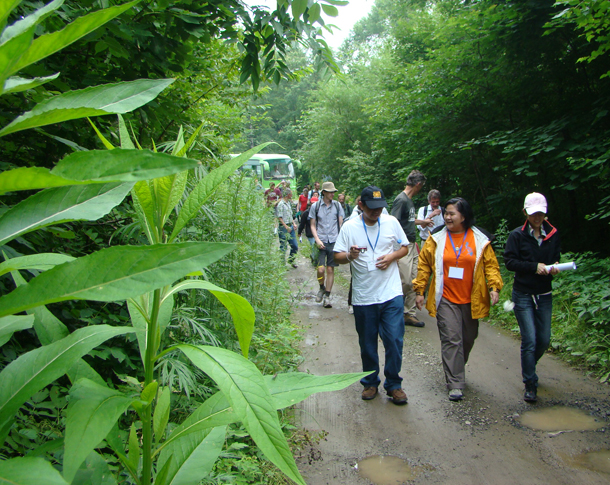
Working group participants in Changbaishan Station.
by Tania Brenes 

Between the 13th and 29th of July, 2011 CTFS-SIGEO scientists are participating in an Analytical Workshop and Symposium in China. We are currently staying at the Changbaishan Field Station in the province of Jilin in Northeast China doing analytical work. There are over 60 participants from 16 different countries and regions. For two weeks, different work groups will be focused on analyzing CTFS-SIGEO data  to answer questions about long term changes in forest dynamics, phylogenetics and diversity, functional traits, spatial patterns, carbon and biomass and seedling recruitment. Our analytical work is complemented by informal talks and the exciting cultural diversity of the group.

The workshop will end with a two day symposium in Beijing on “Diversity and Forest Change”. This is the first of a series of five workshops funded by NSF-US and NSF-China, and was organized by CTFS-SIGEO and CforBio.
Participants walk to the field station.

September 22, 2010

Community Phylogenetics Workshop Held in Beijing

by Yanjun Du

The Institute of Botany of the Chinese Academy of Sciences (IBCAS) hosted CTFS-SIGEO partners in Beijing on 31 July - 6 August for a workshop on community phylogenetics. Nathan Swenson from Michigan State University gave a series of seminars on phylogenetic approaches to diversity, dispersion, and trait evolution. Xiangcheng Mi, Haibao Ren, Jiangshan Lai, Qiong Ding, and Jinlong Zhang led workshops on the application of R and Phylocom to phylogenetic research.


Fifty-five participants from 8 forest dynamics plots in the Chinese Forest Biodiversity Monitoring Network attended the workshop, representing IBCAS, the Institute of Microbiology CAS, South China Botanical Garden CAS, the Institute of Applied Ecology CAS, Wuhan Botanical Garden CAS, and Xishuangbanna Tropical Botanical Garden CAS.

December 9, 2009

Data-analysis workshop in Beijing

Text contributed by Dr. Mi Xiangcheng

To better understand the mechanisms of biodiversity maintenance in forests of the Chinese Forest Biodiversity Monitoring Network (CForBio), the Biodiversity Committee of the Chinese Academy of Sciences and CTFS hosted a workshop on data analysis and management in Beijing on 14-24 October 2009. The workshop was led by Drs. Richard Condit, Shameema Esufali, and Yu-Yun Chen. Twenty-eight people from seven CForBio plots participated in the workshop.


Condit and Esufali used BCI plot data to demonstrate a variety of data-analysis methods, including maximum likelihood and MCMC. These demonstrations illustrated in detail the advantages and disadvantages of each method. Participants also received instruction in R and completed a series of computations.

The course on data management used the Gutianshan plot’s database for instruction in the establishment, management, and maintenance of plot data, all of which are essential to CTFS research. The intensive two-week workshop greatly enhanced participants’ ability to analyze and manage data, further strengthening by extension the entire network’s ability to investigate forest dynamics.


November 21, 2009

China climate center welcomes citizen scientists

The opening of China’s Regional Climate Centre, the newest of five international sites where HSBC bank volunteers (called “Climate Champions”) work alongside scientists to study the effects of climate change on forests, was celebrated at Gutianshan Nature Reserve, China, on 22 September 2009. The HSBC Climate Partnership—a collaboration between HSBC, the Smithsonian Tropical Research Institute, Earthwatch Institute, WWF, and The Climate Group—has four other Regional Climate Centers in India, Brazil, the US, and the UK.


Earthwatch and the Institute of Botany at the Chinese Academy of Sciences host HSBC Climate Champions (kneeling above) at Gutianshan Nature Reserve in eastern China, where they measure tree growth and litter production using techniques developed by CTFS.

In 2005, Dr. Ma Keping (below left, with Teresa Au of HSBC) and colleagues established a long-term 24-ha forest-monitoring site in warm-temperate evergreen forest at Gutianshan as part of the Chinese Forest Biodiversity Monitoring Network, a partner network of the Center for Tropical Forest Science.