August 11, 2011

NSF-Supported Scientific Exchange Fellow Erin Kurten Expands CTFS-SIGEO Partnerships in China

The National Science Foundation grant to CTFS-SIGEO (DEB-1046113), in addition to supporting the recent workshop and symposium, provides support for a program of scientific exchange between the US and China. Young US-based researchers are spending periods of one to three months in collaborating labs in China to pursue studies on the dimensions of biological diversity in the world’s forests. Dr. Erin Kurten, post-doctoral fellow with CTFS at the Arnold Arboretum of Harvard University, is the first of these fellows and will spend one month in Shenyang, home of the Chinese Academy of Science’s Institute for Applied Ecology.

While in Shenyang, Erin is working directly with Dr. Zhanqing Hao (Professor and Head of the Research Center of Forest Ecology and Forestry Eco-Engineering at CAS) and his research group. Erin is helping develop of a set of guidelines for focal tree-based monitoring of tree phenology in CForBio forest plots. Additionally, she is collaborating with group members Dr. Xugao Wang and graduate student Yuqiang Zhao on a project to understand the mechanisms underlying a set of previously described positive and negative tree species associations.

Dr. Erin Kurten of CTFS- SIGEO works with Dr. Xugao Wang of the Chinese Academy of Sciences

Erin has been warmly welcomed by Dr. Hao’s group; they have helped her settle into Shenyang and are introducing her to the culinary diversity of Northeastern China. With more intellectual and culinary collaborations to come, Erin’s month in Shenyang promises to be a good one!

August 5, 2011

NSF-US and NSF-China Build Foundation for Bilateral Science Collaboration through support of CTFS-SIGEO and CForBio Science and Training Partnership

A delegation from the US National Science Foundation met with counterparts from NSF-China in Beijing, China, on 27-28 July 2011, at a Biodiversity Symposium organized by CTFS-SIGEO and the Chinese Forest Biodiversity Monitoring Network (CForBio).

Representatives of both NSF and NSF-C spoke of the importance of their jointly funded program, “Dimensions of Biodiversity”, for building partnerships and strengthening capacity in biodiversity science between the US and China. The joint funding provides five years of support for workshops, scientific exchange visits, and the enhancement of bioinformatics tools for biodiversity research.

The goal of the program is to advance understanding of the multiple dimensions of biodiversity and how those dimensions relate to the resilience of forest communities. The long-term sustainability of forests and the services they provide depend on our ability to predict forest responses to changes in climate and land-use at a global scale.

Dimensions of Biodiversity Symposium, Beijing, China.

The NSF delegation included Penelope Firth, Deputy Director, Division of Environmental Biology; William Chang, Head of the East Asia and Pacific Program and Interim Executive Officer of International Science and Engineering; Emily Ashworth, Director of NSF China Office; and Program Officers James Wang, Sarah Mathews and Alan Tessier.

The NSF-China delegation included Zhenliang Yu, Ecology Division Director; Yinghui Liu, Ecology Program Director; Huai Chen, Director Division of American, Oceanian and Eastern European Programs; and Xiuping Liu, Program Manager, Division of American, Oceanian and Eastern European Programs.

July 19, 2011

CTFS-SIGEO/CForBio Analytical Workshop and Symposium in China Underway

Working group participants in Changbaishan Station.
by Tania Brenes 

Between the 13th and 29th of July, 2011 CTFS-SIGEO scientists are participating in an Analytical Workshop and Symposium in China. We are currently staying at the Changbaishan Field Station in the province of Jilin in Northeast China doing analytical work. There are over 60 participants from 16 different countries and regions. For two weeks, different work groups will be focused on analyzing CTFS-SIGEO data  to answer questions about long term changes in forest dynamics, phylogenetics and diversity, functional traits, spatial patterns, carbon and biomass and seedling recruitment. Our analytical work is complemented by informal talks and the exciting cultural diversity of the group.

The workshop will end with a two day symposium in Beijing on “Diversity and Forest Change”. This is the first of a series of five workshops funded by NSF-US and NSF-China, and was organized by CTFS-SIGEO and CforBio.
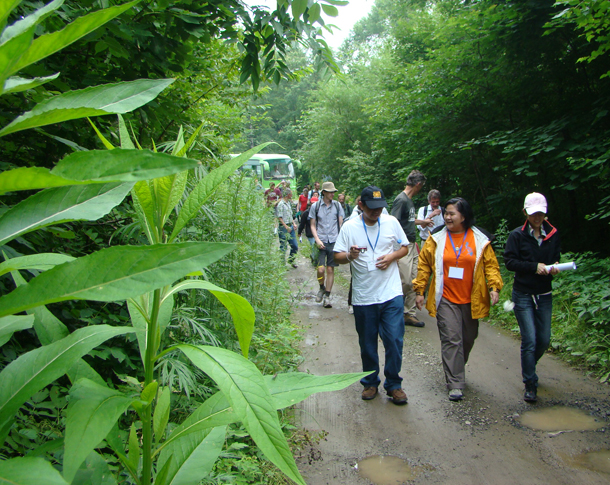
Participants walk to the field station.

July 6, 2011

Hong Kong Global Forest Observatory Plot Launches with Workshop and Ceremony

On June 25, the Kadoorie Institute of Hong Kong University celebrated the opening of a new forest dynamics plot in Hong Kong. HSBC’s Hong Kong Bank Foundation donated more than USD 700,000 over three years for the plot, which will enable scientific research on forest dynamics in relation to climate change while providing opportunities for public to engagement in citizen science.

CTFS Director Stuart Davies and Principal Investigator Billy Hau of Hong Kong University (HKU) led a one-day workshop on June 24, training twenty-five participants in plot establishment following the standard CTFS protocols. Participants came from the Kadoorie Farm and Botanic Garden, the Hong Kong Bird Watching Society, the Agriculture, Fisheries and Conservation Department, and Hong Kong University’s School of Biological Sciences and Lung Fu Shan Environmental Education Centre.

An official launch of the Global Forest Observatory was held on June 25 at the Kadoorie Institute Shek Kong Centre (KISK) where a 1-hectare training plot is also being established. The opening was presided over by Teresa Au (Head of Corporate Sustainability, Asia Pacific Region, HSBC), Dr. Lap-Chee Tsui (Vice Chancellor and President, Hong Kong University) and Joseph Sham Chun-hung (Assistant Director, Agriculture, Fisheries and Conservation Department). The event received attention in the local media, with several news broadcasts and write-ups expressing excitement about the significance of the new research site.

The 20-ha plot is located in a forest ecosystem that has been impacted by humans for over 4,000 years. The initiative will provide valuable insight into the ecology of a regenerating forest at the margin of the tropics, and will provide training opportunities for over 2,000 citizen scientists.

June 30, 2011

Publications: April – June 2011

Heineman, K.D.,  E. Jensen, A. Shapland, B. Bogenrief, S. Tan, R. Rebarber, S. E. Russo. The effects of belowground resources on aboveground allometric growth in Bornean tree species. Forest Ecology and Management 261 (2011) 1820–1832.
Full text


He, F and S.P. Hubbell. Species-area relationships always overestimate extinction rates from habitat loss. Nature 473 (2011) 368–371.
Full text

Feeley, K. J., S.J. Davies, R. Perez, S. P. Hubbell, and R.B. Foster. Directional changes in the species composition of a tropical forest. Ecology, 92(4), 2011, 871–882.
Full text


McMahon, S. M., Harrison, S. P., Armbruster, W. S., Bartlein, P.J., Beale, C, Edwards, M. E., Kattge, J, Midgley, G,  Morin, X,  and Prentice, I C. Improving assessments of climate-change impacts on global biodiversity. Trends in Ecology and Evolution. 2011. Vol. 26, No. 5.
Abstract


Meegaskumbura, M., S. Meegaskumbura, G. Bowatte, K. Manamendra-Arachchi, R. Pethiyagoda, J. Hanken and C.J. Schneider. Taruga (ANURA: RHACOPHORIDAE), a new genus of foam-nesting tree frogs endemic to Sri Lanka. Cey. J. Sci. (Bio. Sci.) 39 (2): 75-94, 2010
Full text


Norghauer, J.M., A. R. Martin, E. E. Mycroft, A. James, S. C. Thomas. Island Invasion by a Threatened Tree Species: Evidence for Natural Enemy Release of Mahogany (Swietenia macrophylla) on Dominica, Lesser Antilles. PLoS ONE 6(4): e18790.
Full text


Pringle, E.G., R.I. Adams, E. Broadbent, P. E. Busby, C. I. Donatti, E. L. Kurten, K. Renton and R. Dirzo. Distinct Leaf-trait Syndromes of Evergreen and Deciduous Trees in a Seasonally Dry Tropical Forest. 2011. Biotropica 43(3): 299–308.
Abstract


Rahbek, C. and R.K. Colwell. Species loss revisited. Nature 473 (2011) 288–289.
Full text
 

Schnitzer, S.A., J.N. Klironomos, J.  HilleRisLambers, L. L. Kinkel, P. B. Reich, K. Xiao, M. C. Rillig, B.A. Sikes, R.M. Callaway, S. A. Mangan, E.H. van Nes, and M. Scheffer. Soil microbes drive the classic plant diversity–productivity pattern. Ecology, 92(2), 2011, pp. 296–303.
Full text


Uriarte, M., M. Anciaes, M.T.B. da Silva, P. Rubim, E. Johnson, and E.M. Bruna. Disentangling the drivers of reduced long-distance seed dispersal by birds in an experimentally fragmented landscape. Ecology, 92(4), 2011, 924–937.
Abstract


Visser, Marco D., E. Jongejans, M. van Breugel, P. A. Zuidema, Y. Chen, A. Rahman K. and H. de Kroon. Strict mast fruiting for a tropical dipterocarp tree: a demographic cost–benefit analysis of delayed reproduction and seed predation. Journal of Ecology, published online 23 Mar 2011.
Abstract

June 24, 2011

CTFS-SIGEO Colleagues Work Towards Real-time Automated Monitoring of Forests and Environmental Change

Workshop participants, back row: Ned Friedman (Arnold Arboretum), Jon Chappell (SAO), Carlos Corrada (UPR), Stuart Davies (CTFS-SIGEO), Christopher Thomas (Oregon State), Biff Bermingham (STRI), Cassidy Rankine (UAlberta), Jess Parker (SERC), Matteo Detto (CTFS-SIGEO), Bill Munger (Harvard), Evan DeLucia (UIllinois), Michael Schindlinger (Leslie), Frank Levinson, Rich Camili (WHOI), Larry Madin (WHOI); front row: David Kenfack (CTFS-SIGEO), Lewis Girod (MIT), Erin Kurten (CTFS-AA), Helene Muller-Landau, Lucy Hutyra (BU), Charlie Harvey (MIT), Scott Gallagher (WHOI).

On June 13-14, twenty-three engineers, environmental scientists and ecologists met at the Arnold Arboretum of Harvard University to discuss the potential for a standardized instrumentation platform for CTFS-SIGEO sites around the world. The proposed instrumentation platform would provide real-time data on tree growth and health, animal sounds and movements, and climatic and other environmental fluctuations. Real-time data of this sort will provide a powerful addition to how CTFS attempts to link fluctuations in physical and environmental conditions with forest change.

Frank Levinson opened the meeting with his vision for developing a forest ecology “tailplate” – a standardized infrastructure that individual investigators could depend on to easily replicate studies across sites.

Participants gave presentations on a wide variety of potential platform components (including meteorological sensors, automated dendrometer bands, eddy flux systems, cameras and hyperspectral sensors, sound recording equipment and associated analysis programs) and the scientific questions these would address. Participants from Woods Hole Oceanographic Institute (WHOI) presented on similar instrumentation initiatives for oceanographic measurements, and relevant lessons for developing a terrestrial platform.

There was wide agreement that with recent technological advances, the time is right to develop and deploy such a standardized instrumentation platform for CTFS-SIGEO sites. Standardized, long-term measurements across CTFS-SIGEO sites would enable robust comparisons among sites, quantification of interannual variation, and better detection of any long-term change.

June 21, 2011

CTFS-SIGEO Program Manager Appointed: Liz Delaney

We are pleased to announce that Liz Delaney has joined the Center for Tropical Forest Science-Smithsonian Institution Global Earth Observatory (CTFS-SIGEO) as Program Manager for the network.
Liz joins CTFS after working at Earthwatch Institute as the Interim Director of Field Centers, and before that as Program Manager for Regional Climate Centers (part of the HSBC Climate Partnership). Before joining Earthwatch, Liz lived for five years in rural Costa Rica where she worked as a science teacher and curriculum developer at a bilingual environmental education center, and has previously worked as an environmental consultant for the EPA. Liz got her Master’s in Science Education from The George Washington University, and her undergraduate degree in Biology from Boston College. Liz is fluent in Spanish and enjoys traveling, running, spending time with her husband and daughter, and the outdoors. She will be based at the CTFS office at the Arnold Arboretum of Harvard University.