Showing posts with label Grants. Show all posts

October 3, 2016

ForestGEO Researchers Receive New Funding to Explore Forest Function

A National Science Foundation grant of nearly $1 million will fund new research at two ForestGEO sites – Harvard Forest and Smithsonian Environmental Research Center (SERC) starting later this year.  The $965,000 award was granted to University of Maryland Associate Professor and ForestGEO partner Nathan Swenson, ForestGEO Director Stuart Davies, and Temperate Forest Program Coordinator Sean McMahon to investigate forest function from genes to canopies. The research aims to quantify how inter- and intra-annual differential gene expression in leaves and genotypic differentiation are related to leaf level gas exchange, fine scale measurements of tree growth, and carbon dioxide flux measured at the scale of forest canopies.


Forests’ ability to absorb and store carbon dioxide makes them integral to regulating climate change. But the thousands of individual trees within a forest vary greatly in their physiological and growth response to environmental change. In order to predict future forest functioning, individual leaf processes need to be linked to larger forest level processes. This research will use innovative new technology and specific measurements of individual tree growth and physiology to address this challenge.  

Harvard Forest, USA
“The work uniquely scales from genes to ecosystems while simultaneously considering spatial and temporal variation in forest function”, said Swenson. “Ecology is entering a exciting new age where the substantial advances made in genome and transcriptome sequencing can now be utilized in non-model organisms in the wild. Coupling these advances in ‘omics with detailed measurements of plant performance from the leaf to the canopy scale was thought to be impossible only a few years ago and it is expected to transform ecology”.

Harvard Forest and SERC are also part of the National Ecological Observatory Network (NEON), which is supported by NSF. It is a network of ecological observation facilities with sites across the U.S. that gathers and analyzes data on climate change, land use change, invasive species, and how these influence biodiversity and natural resources. Goals of NEON include forecasting continental-scale environmental change, informing natural resource decisions, and engaging the next generation of scientists.

August 3, 2016

Workshop fosters cooperation and collaboration for group of global forest ecologists

The Center for Tropical Forest Science - Forest Global Earth Observatory (CTFS-ForestGEO) in partnership with the Chinese Forest Biodiversity Monitoring Network (CForBio) held its annual data analysis workshop this month. The workshop is supported by the National Science Foundation (NSF) through the Dimensions of Biodiversity Program and was hosted by the Chinese Academy of Forestry at the Jianfengling 60ha forest plot on Hainan Island in southeast China. The grant, entitled “Dimensions US-China: Integrating the functional, phylogenetic and genetic components of diversity for improved an understanding of forest change and biodiversity” funds annual workshops for graduate students, postdocs, and senior scientists to gather and collaborate on their research and exchange data and ideas.

The group included 65 participants hailing from 20 countries spanning North and South America, Africa, Europe, and Asia. All participants worked diligently and were pleased with the amount of science and training accomplished during the two week workshop.

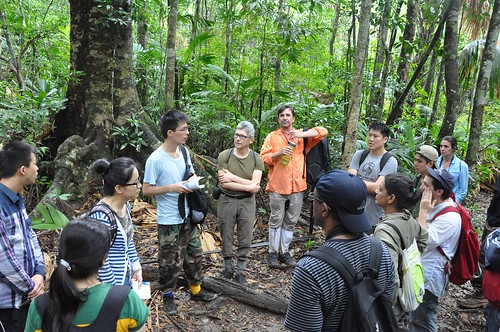
Workshop participants in Hainan, China (photo credit: Yao Tze Leong)
Breakout group on demography related to diversity (Yao Tze Leong)
The workshop mission was to bring together a global network of forest researchers to foster research advances and scientific collaborations. This is carried out though an ongoing collaboration between CTFS – ForestGEO and the CForBio with the Chinese Academy of Sciences. Among 51 plots in the CTFS-ForestGEO and CForBio networks, a vast amount of research is being done on how dimensions of biodiversity are changing in forests. Forests everywhere are under threat from deforestation, pollution, invasive species, degradation, and climate and atmospheric change. Understanding and analyzing the data on tree species functional traits, phylogeny, and genetics from the network will inform predictions of forests’ dynamic responses to anthropogenic change.

Sabrina Russo mentors a breakout group (Yao Tze Leong)
Participants worked tirelessly to curate and analyze the immense amount of data pouring out of the global network. The approach centered around small “break out” groups focused on how the dimensions of forest biodiversity regulate the dynamics of tropical forests around the world. Each group received close hands-on mentoring by senior scientists associated with Smithsonian Institute and CTFS-ForestGEO. Participants were guided through the analyses and writing stages of their projects in order to produce manuscripts intended for submission to a peer-reviewed scientific journal.

Erandathi Ekanayake presents findings to her group (Yao Tze Leong)
This intense work schedule was punctuated by lively group meals, happy hours, and lots of joking and cultural exchange. Each day was bookended by lectures from the postdocs and scientists in attendance. Among the notable mentors this year was Steve Hubbell who gave a lecture on forest diversity. A highlight for many participants was the day trip to the Jianfengling 60 ha forest dynamic plot, which is a tropical submontane rainforest notable for its adaptation to seasonal typhoon disturbances. The 65 researchers all trekked the 5 km through bouts of torrential downpours- a proud testament to the fieldwork experience and fortitude possessed by the participants!

Han Xu leads the field trip to the Jianfengling plot (Yao Tze Leong)
Aaron Hogan takes a dbh measurement during the field trip (Yao Tze Leong)
The workshop culminated in an all-day symposium where each participant gave 5-minute lightning talks about their projects and the progress they had made during the workshop. There is no doubt that dozens of CTFS-ForestGEO manuscripts published this year will be largely thanks to the hard work accomplished in Hainan!  

The friendships and connections fostered among participants made the last day bittersweet, but all agreed to prioritize attending the next annual workshop in the USA. 


2016 Workshop in Hainan, China

September 8, 2011

CTFS-SIGEO Grant Recipient Faith Inman-Narahari Investigates Seedling Dynamics in Hawai’i

Doctoral candidate Faith Inman-Narahari recently established 64 census stations to measure seed rain and seedling distribution, abundance, survival and growth within the mapped Laupāhoehoe Forest Dynamics Plot, part of the Hawaiian Permanent Plot Network (HIPPNET). Supported by a CTFS-SIGEO research grant, Faith has applied ecological theory and studied forest plot dynamics patterns in the unique testing ground of the Hawaiian Islands. The most remote archipelago in the world, Hawai’i contains 25 of the 35 global life zones and is known for relatively low levels of tree diversity and high levels of endemism. 

The results of the study provide a comparison between the Hawaiian forests and other mainland and island forests. Interestingly, based on comparisons of published data from five other CTFS-SIGEO plot studies, Inman-Narahari has found that dispersal and habitat limitation and the proportion of species with significant habitat associations does not show a clear relationship with global diversity patterns. The project will continue with support from the USDA Forest Service Institute of Pacific Islands Forestry (IPIF), the University of Hawai’i, the University of California Los Angeles, and the Garden Club of America. Future publications will include tests of the effects of habitat and negative density dependence on growth and survival in both wet and dry Hawaiian forest. More information about Faith’s research is available through UCLA and on her blog

Faith Inman-Narahari records data in Hawaiian forest plot


October 21, 2010

CTFS Awarded NSF Grant to Study Diversity and Forest Change

The US National Science Foundation’s Dimensions of Biodiversity initiative has awarded CTFS $631,640 over five years to study the taxonomic, genetic, and functional dimensions of tree diversity and their impact on forest structure and function. The Arnold Arboretum of Harvard University will manage the grant, and the Chinese National Science Foundation will provide matching funds.

The research will combine long-term temperate and tropical forest studies across entire tree communities to parameterize models that incorporate functional and genetic variation among species to test predictions about current and future changes in forests. Integration of multiple dimensions of biodiversity will significantly increase understanding of how forests are structured‹a critical and necessary step toward predicting how these systems will respond to global change.

The project will involve many partners sites of the global CTFS-SIGEO network.

_________________________________________________________

Dimensions IRCN: Diversity and Forest Change: Characterizing functional, phylogenetic, and genetic contributions to diversity gradients and dynamics in tree communities

Project Summary


Understanding diversity’s impact on forest structure and function: The project will bring together two existing forest research networks in the US and China to advance understanding of how taxonomic, functional, and genetic dimensions of diversity structure tree communities and affect their resilience to global change. Together these networks maintain 24 large-scale forest plots in tropical and temperate forests in Asia and the Americas, providing data on the demography, functional traits, phylogenetic relatedness, and environmental preferences of thousands of species. Through a series of symposia, analytical workshops, and international scientific exchanges, these data will be used to ask: (i) what functional traits underlie species demographics and distributions across environmental gradients, (ii) how functional traits and phylogenetic relatedness of communities link to forest function; and (iii) how functional traits and environmental tolerances vary among individuals within species.; and (iv) how gene flow contributes to genetic diversity at local and regional scales. By combining long-term temperate and tropical forest studies across entire tree communities, we will be able to parameterize models that incorporate knowledge about functional and genetic variation among species to test predictions about current and future changes in the forests.

Building capacity in biodiversity research
: The project will be implemented through a series of capacity-building and training initiatives that will expand science and enhance collaboration between the US and China. The strengthening of the network of forest research plots in Asia and the Americas will have long-term benefits for American and Chinese researchers examining the role of forests in a changing global environment. Through workshops and symposia focused on the relationships between taxonomic, functional, and genetic dimensions of biodiversity and ecosystem processes, we will engage approximately 100 students and early-career scientists over five years. An international scientific exchange program will enable 10 US students and early-career researchers to spend 3 months in collaborating institutions in China. Chinese scientists will have similar opportunities in the US through a parallel proposal to NSF-China. These scientists will be drawn from the US, China, and other developing countries in Asia and the Americas. In addition, the scientific workshops will result in the development of new analytical tools and data compilations that will be made openly available through the web.

October 7, 2010

2010 Research Grants Program Recipients

CTFS is pleased to announce the 2010 Research Grants Program recipients. This year’s cycle attracted 58 proposals requesting more than USD $1,000,000. Out of this pool, 11 proposals were selected for full or partial funding. Thank you to all applicants for your interest in the CTFS network. The deadline for the next grant cycle is 1 April 2011. See our website for application details.

Click here to view the names of the recipients and their proposal titles.

2010 CTFS Research Grants Program Recipients

Lei Chen, “The role of density dependence in community assembly: Implications from adult tree pattern and seedling dynamics in both subtropical and tropical forest.” Gutianshan, China; BCI, Panama.

Neal Enrigh, “Understanding the population dynamics of Nageia motleyi (Podocarpaceae) in lowland tropical rainforests of South-east Asia.” Pasoh, Malaysia.

Gonçalo Ferraz and Cintia Cornelius, “Predicting occurrence of cavity-nesting birds from tree demographic data.” Manaus, Brazil.

David L. Gorchov, Melissa K. McCormick, Dennis F. Whigham, “Exotic Plant Invasion in Temperate Deciduous Forest: Patterns and Processes.” SERC, USA.

Steven W. Kembel, Jessica L. Green, “Quantifying the scaling of bacterial phyllosphere diversity: The role of space, environment, and host plant attributes.”
BCI, Panama.

Madhava Meegaskumbura and Suyama Meegaskumbura, “Determining microclimatic envelopes and monitoring populations of Sri Lankan Shrub-Frogs in Sinharaja 25 ha. plot to understand finer scale determinants of their distribution, reproduction and survival.” Sinharaja, Sri Lanka.

Eadaoin M.I. Quinn, “Does age-related crown thinning occur in canopy-dominant tropical trees?” BCI, Panama.

Siewe Siewe Siewe and Jacqueline Vadjunec, “Degradation and carbon stocks dynamics: An analysis of the anthropogenic impact on deforestation and degradation in the Korup National Park.” Korup, Cameroon.

Erin Spear, “Agents of change: Identifying phytopathogens and their contributions to tree diversity.” BCI, Panama.

Pimonrat Tiansawat, “Ecological significance of seed traits in the genus Macaranga.” Lambir, Malaysia.

November 7, 2009

2009 CTFS Research Grants

CTFS is pleased to announce the recipients of the 2009 CTFS Research Grants.

The purpose of these grants is to enhance the quality of science conducted at the plots and to broaden the use of the plots by a diversity of researchers. This year we received 47 proposals. The competition was highly competitive. The ten proposals listed below were selected for full or partial support.

For further information about the CTFS Research Grants Program, please see the website (www.ctfs.si.edu). The closing date for 2010 awards will be April 1st, 2010. To see a list of recipients and proposal titles, click

CTFS Research Grants Program - 2009 Award Recipients:

Luciana F. Alves: "Assessment of aboveground carbon pools of a tropical moist forest" (Ilha do Cardoso, Brazil)

Robyn J. Burnham: "Liana diversity and abundance in the 25-ha plot, Manaus, Brazil" (Manaus, Brazil)

Britta Denise Hardesty: "Where have all the parents gone – using inverse modeling to predict the location of unobserved parents in tropical forests" (BCI)

Faith Inman-Narahari: "Seed rain and seedling recruitment in Hawai’i" (Laupahoehoe, Hawai'i)

John D. Parker: "Impacts of alien plant invasions and overabundant deer on forest regeneration and community dynamics in a temperate deciduous forest" (SERC, Maryland)

Xiaojuan Liu: Relationships between traits and species distribution (Gutianshan, China)

Qiao Lu & Matthew Warren: "Modeling aboveground plant litter chemistry as a driver of surface soil chemical heterogeneity" (Xishuangbanna, China)

Nadja Rüger: "Parameterization of an individual-based forest model" (BCI, Panama)

Watana Sakchoowong: "Influence of leaf litter composition on selected arthropod assemblages in a lowland tropical rainforest in Thailand" (Khao Chong, Thailand)

Isabelle Witté: "Are boreal forests more structurally complex than temperate or tropical forests, and at which scales? A comparison of tropical, temperate, and boreal mixedwood systems" (SERC, Maryland).