Showing posts with label NSF. Show all posts

October 3, 2016

ForestGEO Researchers Receive New Funding to Explore Forest Function

A National Science Foundation grant of nearly $1 million will fund new research at two ForestGEO sites – Harvard Forest and Smithsonian Environmental Research Center (SERC) starting later this year.  The $965,000 award was granted to University of Maryland Associate Professor and ForestGEO partner Nathan Swenson, ForestGEO Director Stuart Davies, and Temperate Forest Program Coordinator Sean McMahon to investigate forest function from genes to canopies. The research aims to quantify how inter- and intra-annual differential gene expression in leaves and genotypic differentiation are related to leaf level gas exchange, fine scale measurements of tree growth, and carbon dioxide flux measured at the scale of forest canopies.


Forests’ ability to absorb and store carbon dioxide makes them integral to regulating climate change. But the thousands of individual trees within a forest vary greatly in their physiological and growth response to environmental change. In order to predict future forest functioning, individual leaf processes need to be linked to larger forest level processes. This research will use innovative new technology and specific measurements of individual tree growth and physiology to address this challenge.  

Harvard Forest, USA
“The work uniquely scales from genes to ecosystems while simultaneously considering spatial and temporal variation in forest function”, said Swenson. “Ecology is entering a exciting new age where the substantial advances made in genome and transcriptome sequencing can now be utilized in non-model organisms in the wild. Coupling these advances in ‘omics with detailed measurements of plant performance from the leaf to the canopy scale was thought to be impossible only a few years ago and it is expected to transform ecology”.

Harvard Forest and SERC are also part of the National Ecological Observatory Network (NEON), which is supported by NSF. It is a network of ecological observation facilities with sites across the U.S. that gathers and analyzes data on climate change, land use change, invasive species, and how these influence biodiversity and natural resources. Goals of NEON include forecasting continental-scale environmental change, informing natural resource decisions, and engaging the next generation of scientists.

August 11, 2011

NSF-Supported Scientific Exchange Fellow Erin Kurten Expands CTFS-SIGEO Partnerships in China

The National Science Foundation grant to CTFS-SIGEO (DEB-1046113), in addition to supporting the recent workshop and symposium, provides support for a program of scientific exchange between the US and China. Young US-based researchers are spending periods of one to three months in collaborating labs in China to pursue studies on the dimensions of biological diversity in the world’s forests. Dr. Erin Kurten, post-doctoral fellow with CTFS at the Arnold Arboretum of Harvard University, is the first of these fellows and will spend one month in Shenyang, home of the Chinese Academy of Science’s Institute for Applied Ecology.

While in Shenyang, Erin is working directly with Dr. Zhanqing Hao (Professor and Head of the Research Center of Forest Ecology and Forestry Eco-Engineering at CAS) and his research group. Erin is helping develop of a set of guidelines for focal tree-based monitoring of tree phenology in CForBio forest plots. Additionally, she is collaborating with group members Dr. Xugao Wang and graduate student Yuqiang Zhao on a project to understand the mechanisms underlying a set of previously described positive and negative tree species associations.

Dr. Erin Kurten of CTFS- SIGEO works with Dr. Xugao Wang of the Chinese Academy of Sciences

Erin has been warmly welcomed by Dr. Hao’s group; they have helped her settle into Shenyang and are introducing her to the culinary diversity of Northeastern China. With more intellectual and culinary collaborations to come, Erin’s month in Shenyang promises to be a good one!

August 5, 2011

NSF-US and NSF-China Build Foundation for Bilateral Science Collaboration through support of CTFS-SIGEO and CForBio Science and Training Partnership

A delegation from the US National Science Foundation met with counterparts from NSF-China in Beijing, China, on 27-28 July 2011, at a Biodiversity Symposium organized by CTFS-SIGEO and the Chinese Forest Biodiversity Monitoring Network (CForBio).

Representatives of both NSF and NSF-C spoke of the importance of their jointly funded program, “Dimensions of Biodiversity”, for building partnerships and strengthening capacity in biodiversity science between the US and China. The joint funding provides five years of support for workshops, scientific exchange visits, and the enhancement of bioinformatics tools for biodiversity research.

The goal of the program is to advance understanding of the multiple dimensions of biodiversity and how those dimensions relate to the resilience of forest communities. The long-term sustainability of forests and the services they provide depend on our ability to predict forest responses to changes in climate and land-use at a global scale.

Dimensions of Biodiversity Symposium, Beijing, China.

The NSF delegation included Penelope Firth, Deputy Director, Division of Environmental Biology; William Chang, Head of the East Asia and Pacific Program and Interim Executive Officer of International Science and Engineering; Emily Ashworth, Director of NSF China Office; and Program Officers James Wang, Sarah Mathews and Alan Tessier.

The NSF-China delegation included Zhenliang Yu, Ecology Division Director; Yinghui Liu, Ecology Program Director; Huai Chen, Director Division of American, Oceanian and Eastern European Programs; and Xiuping Liu, Program Manager, Division of American, Oceanian and Eastern European Programs.

July 19, 2011

CTFS-SIGEO/CForBio Analytical Workshop and Symposium in China Underway

Working group participants in Changbaishan Station.
by Tania Brenes 

Between the 13th and 29th of July, 2011 CTFS-SIGEO scientists are participating in an Analytical Workshop and Symposium in China. We are currently staying at the Changbaishan Field Station in the province of Jilin in Northeast China doing analytical work. There are over 60 participants from 16 different countries and regions. For two weeks, different work groups will be focused on analyzing CTFS-SIGEO data  to answer questions about long term changes in forest dynamics, phylogenetics and diversity, functional traits, spatial patterns, carbon and biomass and seedling recruitment. Our analytical work is complemented by informal talks and the exciting cultural diversity of the group.

The workshop will end with a two day symposium in Beijing on “Diversity and Forest Change”. This is the first of a series of five workshops funded by NSF-US and NSF-China, and was organized by CTFS-SIGEO and CforBio.
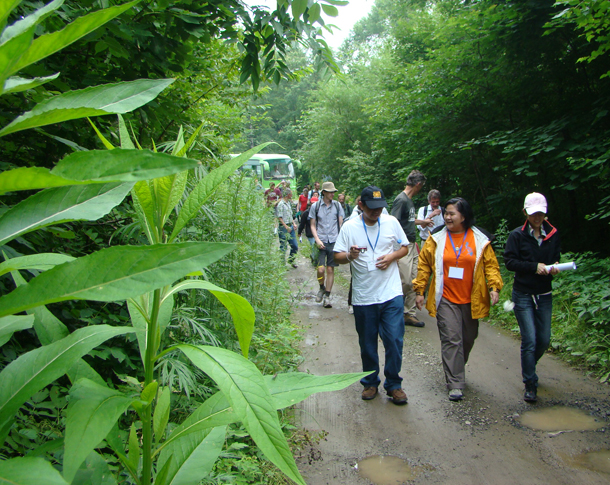
Participants walk to the field station.

October 21, 2010

CTFS Awarded NSF Grant to Study Diversity and Forest Change

The US National Science Foundation’s Dimensions of Biodiversity initiative has awarded CTFS $631,640 over five years to study the taxonomic, genetic, and functional dimensions of tree diversity and their impact on forest structure and function. The Arnold Arboretum of Harvard University will manage the grant, and the Chinese National Science Foundation will provide matching funds.

The research will combine long-term temperate and tropical forest studies across entire tree communities to parameterize models that incorporate functional and genetic variation among species to test predictions about current and future changes in forests. Integration of multiple dimensions of biodiversity will significantly increase understanding of how forests are structured‹a critical and necessary step toward predicting how these systems will respond to global change.

The project will involve many partners sites of the global CTFS-SIGEO network.

_________________________________________________________

Dimensions IRCN: Diversity and Forest Change: Characterizing functional, phylogenetic, and genetic contributions to diversity gradients and dynamics in tree communities

Project Summary


Understanding diversity’s impact on forest structure and function: The project will bring together two existing forest research networks in the US and China to advance understanding of how taxonomic, functional, and genetic dimensions of diversity structure tree communities and affect their resilience to global change. Together these networks maintain 24 large-scale forest plots in tropical and temperate forests in Asia and the Americas, providing data on the demography, functional traits, phylogenetic relatedness, and environmental preferences of thousands of species. Through a series of symposia, analytical workshops, and international scientific exchanges, these data will be used to ask: (i) what functional traits underlie species demographics and distributions across environmental gradients, (ii) how functional traits and phylogenetic relatedness of communities link to forest function; and (iii) how functional traits and environmental tolerances vary among individuals within species.; and (iv) how gene flow contributes to genetic diversity at local and regional scales. By combining long-term temperate and tropical forest studies across entire tree communities, we will be able to parameterize models that incorporate knowledge about functional and genetic variation among species to test predictions about current and future changes in the forests.

Building capacity in biodiversity research
: The project will be implemented through a series of capacity-building and training initiatives that will expand science and enhance collaboration between the US and China. The strengthening of the network of forest research plots in Asia and the Americas will have long-term benefits for American and Chinese researchers examining the role of forests in a changing global environment. Through workshops and symposia focused on the relationships between taxonomic, functional, and genetic dimensions of biodiversity and ecosystem processes, we will engage approximately 100 students and early-career scientists over five years. An international scientific exchange program will enable 10 US students and early-career researchers to spend 3 months in collaborating institutions in China. Chinese scientists will have similar opportunities in the US through a parallel proposal to NSF-China. These scientists will be drawn from the US, China, and other developing countries in Asia and the Americas. In addition, the scientific workshops will result in the development of new analytical tools and data compilations that will be made openly available through the web.