Showing posts with label Workshops. Show all posts

August 3, 2016

Workshop fosters cooperation and collaboration for group of global forest ecologists

The Center for Tropical Forest Science - Forest Global Earth Observatory (CTFS-ForestGEO) in partnership with the Chinese Forest Biodiversity Monitoring Network (CForBio) held its annual data analysis workshop this month. The workshop is supported by the National Science Foundation (NSF) through the Dimensions of Biodiversity Program and was hosted by the Chinese Academy of Forestry at the Jianfengling 60ha forest plot on Hainan Island in southeast China. The grant, entitled “Dimensions US-China: Integrating the functional, phylogenetic and genetic components of diversity for improved an understanding of forest change and biodiversity” funds annual workshops for graduate students, postdocs, and senior scientists to gather and collaborate on their research and exchange data and ideas.

The group included 65 participants hailing from 20 countries spanning North and South America, Africa, Europe, and Asia. All participants worked diligently and were pleased with the amount of science and training accomplished during the two week workshop.

Workshop participants in Hainan, China (photo credit: Yao Tze Leong)
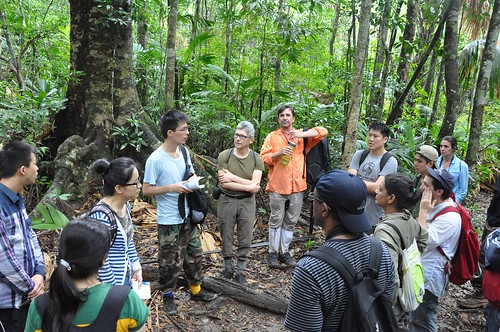
Breakout group on demography related to diversity (Yao Tze Leong)
The workshop mission was to bring together a global network of forest researchers to foster research advances and scientific collaborations. This is carried out though an ongoing collaboration between CTFS – ForestGEO and the CForBio with the Chinese Academy of Sciences. Among 51 plots in the CTFS-ForestGEO and CForBio networks, a vast amount of research is being done on how dimensions of biodiversity are changing in forests. Forests everywhere are under threat from deforestation, pollution, invasive species, degradation, and climate and atmospheric change. Understanding and analyzing the data on tree species functional traits, phylogeny, and genetics from the network will inform predictions of forests’ dynamic responses to anthropogenic change.

Sabrina Russo mentors a breakout group (Yao Tze Leong)
Participants worked tirelessly to curate and analyze the immense amount of data pouring out of the global network. The approach centered around small “break out” groups focused on how the dimensions of forest biodiversity regulate the dynamics of tropical forests around the world. Each group received close hands-on mentoring by senior scientists associated with Smithsonian Institute and CTFS-ForestGEO. Participants were guided through the analyses and writing stages of their projects in order to produce manuscripts intended for submission to a peer-reviewed scientific journal.

Erandathi Ekanayake presents findings to her group (Yao Tze Leong)
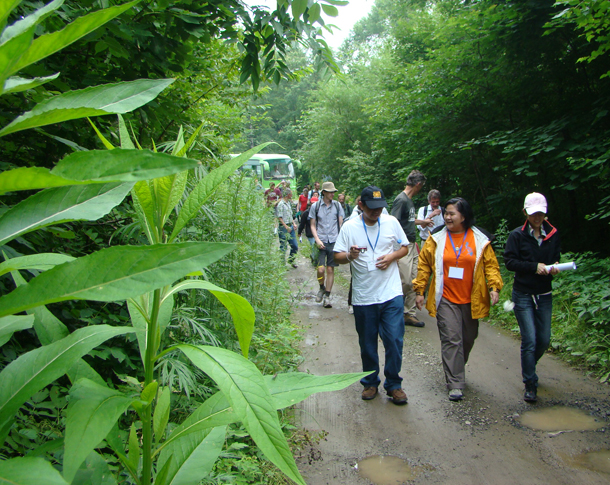
This intense work schedule was punctuated by lively group meals, happy hours, and lots of joking and cultural exchange. Each day was bookended by lectures from the postdocs and scientists in attendance. Among the notable mentors this year was Steve Hubbell who gave a lecture on forest diversity. A highlight for many participants was the day trip to the Jianfengling 60 ha forest dynamic plot, which is a tropical submontane rainforest notable for its adaptation to seasonal typhoon disturbances. The 65 researchers all trekked the 5 km through bouts of torrential downpours- a proud testament to the fieldwork experience and fortitude possessed by the participants!

Han Xu leads the field trip to the Jianfengling plot (Yao Tze Leong)
Aaron Hogan takes a dbh measurement during the field trip (Yao Tze Leong)
The workshop culminated in an all-day symposium where each participant gave 5-minute lightning talks about their projects and the progress they had made during the workshop. There is no doubt that dozens of CTFS-ForestGEO manuscripts published this year will be largely thanks to the hard work accomplished in Hainan!  

The friendships and connections fostered among participants made the last day bittersweet, but all agreed to prioritize attending the next annual workshop in the USA. 

2016 Workshop in Hainan, China

December 15, 2011

CTFS-SIGEO Celebrates 20 Years of Service from Suzanne Lao

Suzanne Lao, CTFS-SIGEO data manager, began her career at the Smithsonian in Panama as a statistician for the Galeta Oil Spill Project in Naos, and then quickly shifted to CTFS, where she has stayed for almost two decades. Managing the data from the BCI 50 hectare plot has been Suzanne's main responsibility during her many years with CTFS. She recently mentioned that the high quality of the BCI data has also benefited from the great working relationship that she has with colleagues Rolando Pérez and Salomón Aguilar. Suzanne has taken experiences learned from BCI data management and used them to help other sites manage their data. Suzanne has also played a key role in training workshops for the network. Most recently, she has worked to migrate plot data into a modern web-accessible database system, helping transform the way CTFS partners manage and use their data.


Suzanne recently said that the best part of working for CTFS-SIGEO has been getting to know collaborators from different sites, first via email, and then through workshops. She calls the CTFS-SIGEO network a "family," despite differences in language, culture, and scientific approaches. Suzanne is proud of all she has achieved during her years with STRI, and is grateful for her colleagues, particularly Rick Condit, who supports her in learning new database and analytical tools. She looks forward to meeting new people and continuing to advance her knowledge as STRI and CTFS-SIGEO grow and change. The entire CTFS-SIGEO community thanks Suzanne for her commitment, expertise, and dedication to the global network.

October 14, 2011

Regional Meetings Promote Collaboration Between South American CTFS-SIGEO Plots


From 19-24 September 2011, scientists from several Neotropical forest plots met in Brazil to outline research goals and identify opportunities for increased regional collaboration. Participants also presented their work at the 10th Brazilian Congress of Ecology symposium, which focused on current research in large-scale plot networks such as CTFS-SIGEO, the São Paulo Permanent Plot network (PPP) and the Bolivian Forest Research Institute (IBIF). Meeting and symposium participants included Alvaro Duque from the National University of Colombia- Sede Medellin  and PI for the Amacayacu plot, Alberto Vicentini from the National Institute of Amazonian Research (INPA) and PI for the Manaus plot, Renato Valencia from the Papal Catholic University of Ecuador (PUCE) and PI for the Yasuni plot, Alexandre de Oliveira, from the University of São Paulo and PI for the Manaus and Ilha do Cardoso plots, and Tania Brenes, Neotropical Coordinator for CTFS-SIGEO. Researchers also had the unique opportunity to visit the Ilha do Cardoso plot, pictured below.  This first-of-its-kind regional meeting was a great success and will lead to expanded regional research collaborations.

Ilha do Cardoso forest plot

August 5, 2011

NSF-US and NSF-China Build Foundation for Bilateral Science Collaboration through support of CTFS-SIGEO and CForBio Science and Training Partnership

A delegation from the US National Science Foundation met with counterparts from NSF-China in Beijing, China, on 27-28 July 2011, at a Biodiversity Symposium organized by CTFS-SIGEO and the Chinese Forest Biodiversity Monitoring Network (CForBio).

Representatives of both NSF and NSF-C spoke of the importance of their jointly funded program, “Dimensions of Biodiversity”, for building partnerships and strengthening capacity in biodiversity science between the US and China. The joint funding provides five years of support for workshops, scientific exchange visits, and the enhancement of bioinformatics tools for biodiversity research.

The goal of the program is to advance understanding of the multiple dimensions of biodiversity and how those dimensions relate to the resilience of forest communities. The long-term sustainability of forests and the services they provide depend on our ability to predict forest responses to changes in climate and land-use at a global scale.

Dimensions of Biodiversity Symposium, Beijing, China.

The NSF delegation included Penelope Firth, Deputy Director, Division of Environmental Biology; William Chang, Head of the East Asia and Pacific Program and Interim Executive Officer of International Science and Engineering; Emily Ashworth, Director of NSF China Office; and Program Officers James Wang, Sarah Mathews and Alan Tessier.

The NSF-China delegation included Zhenliang Yu, Ecology Division Director; Yinghui Liu, Ecology Program Director; Huai Chen, Director Division of American, Oceanian and Eastern European Programs; and Xiuping Liu, Program Manager, Division of American, Oceanian and Eastern European Programs.

July 19, 2011

CTFS-SIGEO/CForBio Analytical Workshop and Symposium in China Underway

Working group participants in Changbaishan Station.
by Tania Brenes 

Between the 13th and 29th of July, 2011 CTFS-SIGEO scientists are participating in an Analytical Workshop and Symposium in China. We are currently staying at the Changbaishan Field Station in the province of Jilin in Northeast China doing analytical work. There are over 60 participants from 16 different countries and regions. For two weeks, different work groups will be focused on analyzing CTFS-SIGEO data  to answer questions about long term changes in forest dynamics, phylogenetics and diversity, functional traits, spatial patterns, carbon and biomass and seedling recruitment. Our analytical work is complemented by informal talks and the exciting cultural diversity of the group.

The workshop will end with a two day symposium in Beijing on “Diversity and Forest Change”. This is the first of a series of five workshops funded by NSF-US and NSF-China, and was organized by CTFS-SIGEO and CforBio.
Participants walk to the field station.

July 6, 2011

Hong Kong Global Forest Observatory Plot Launches with Workshop and Ceremony

On June 25, the Kadoorie Institute of Hong Kong University celebrated the opening of a new forest dynamics plot in Hong Kong. HSBC’s Hong Kong Bank Foundation donated more than USD 700,000 over three years for the plot, which will enable scientific research on forest dynamics in relation to climate change while providing opportunities for public to engagement in citizen science.

CTFS Director Stuart Davies and Principal Investigator Billy Hau of Hong Kong University (HKU) led a one-day workshop on June 24, training twenty-five participants in plot establishment following the standard CTFS protocols. Participants came from the Kadoorie Farm and Botanic Garden, the Hong Kong Bird Watching Society, the Agriculture, Fisheries and Conservation Department, and Hong Kong University’s School of Biological Sciences and Lung Fu Shan Environmental Education Centre.

An official launch of the Global Forest Observatory was held on June 25 at the Kadoorie Institute Shek Kong Centre (KISK) where a 1-hectare training plot is also being established. The opening was presided over by Teresa Au (Head of Corporate Sustainability, Asia Pacific Region, HSBC), Dr. Lap-Chee Tsui (Vice Chancellor and President, Hong Kong University) and Joseph Sham Chun-hung (Assistant Director, Agriculture, Fisheries and Conservation Department). The event received attention in the local media, with several news broadcasts and write-ups expressing excitement about the significance of the new research site.

The 20-ha plot is located in a forest ecosystem that has been impacted by humans for over 4,000 years. The initiative will provide valuable insight into the ecology of a regenerating forest at the margin of the tropics, and will provide training opportunities for over 2,000 citizen scientists.

June 24, 2011

CTFS-SIGEO Colleagues Work Towards Real-time Automated Monitoring of Forests and Environmental Change

Workshop participants, back row: Ned Friedman (Arnold Arboretum), Jon Chappell (SAO), Carlos Corrada (UPR), Stuart Davies (CTFS-SIGEO), Christopher Thomas (Oregon State), Biff Bermingham (STRI), Cassidy Rankine (UAlberta), Jess Parker (SERC), Matteo Detto (CTFS-SIGEO), Bill Munger (Harvard), Evan DeLucia (UIllinois), Michael Schindlinger (Leslie), Frank Levinson, Rich Camili (WHOI), Larry Madin (WHOI); front row: David Kenfack (CTFS-SIGEO), Lewis Girod (MIT), Erin Kurten (CTFS-AA), Helene Muller-Landau, Lucy Hutyra (BU), Charlie Harvey (MIT), Scott Gallagher (WHOI).

On June 13-14, twenty-three engineers, environmental scientists and ecologists met at the Arnold Arboretum of Harvard University to discuss the potential for a standardized instrumentation platform for CTFS-SIGEO sites around the world. The proposed instrumentation platform would provide real-time data on tree growth and health, animal sounds and movements, and climatic and other environmental fluctuations. Real-time data of this sort will provide a powerful addition to how CTFS attempts to link fluctuations in physical and environmental conditions with forest change.

Frank Levinson opened the meeting with his vision for developing a forest ecology “tailplate” – a standardized infrastructure that individual investigators could depend on to easily replicate studies across sites.

Participants gave presentations on a wide variety of potential platform components (including meteorological sensors, automated dendrometer bands, eddy flux systems, cameras and hyperspectral sensors, sound recording equipment and associated analysis programs) and the scientific questions these would address. Participants from Woods Hole Oceanographic Institute (WHOI) presented on similar instrumentation initiatives for oceanographic measurements, and relevant lessons for developing a terrestrial platform.

There was wide agreement that with recent technological advances, the time is right to develop and deploy such a standardized instrumentation platform for CTFS-SIGEO sites. Standardized, long-term measurements across CTFS-SIGEO sites would enable robust comparisons among sites, quantification of interannual variation, and better detection of any long-term change.

May 19, 2011

Workshop on Plot Taxonomic Comparison in Manaus, Brazil

by Tania Brenes
 
On April 10, 2011, the CTFS Neotropical Program organized the first Workshop on Taxonomic Comparison Among Amazonian CTFS Plots, hosted in Manaus, Brazil. This workshop had the participation of botanists and ecologists from three CTFS plots in the Amazon: the Amacayacu plot in Colombia, the Manaus plot in Brazil, and the Yasuni plot in Ecuador. In the workshop, botanists worked with interns and students on the problem of standardizing a methodology and a philosophy of taxonomic delimitation in these hyper-diverse plots. This work will serve as the basis for a developing collaborative research project on taxonomy between the three scientific groups. 

Workshop participants in the top photo from left to right (institution): Alvaro Perez (4), Juan Sebastian Barreto (5), Alberto Vicentini (1), Ana Carla Gómez (1), Ana Segalin (1), Rolando Pérez (2), Alexandre de Oliviera (3), Dairon Cárdenas (5), Carla Lang (1), Jose Luis Camargo (1), Marcel Caritá (3), Tania Brenes (2), Juliana Vendrami (3), Adriane Pantoja (1). 

Institutions: (1) PDBFF, Instituto Nacional de Pesquisas Amazonicas; (2) STRI; (3) Universidad de São Paulo; (4) Pontificia Universidad Católica del Ecuador; (5) Instituto de Investigaciones Amazónicas Sinchi.

Botanists discuss complex plant specimens in the field (left) and at the comparative collection at the BDFFP (right).

September 22, 2010

Community Phylogenetics Workshop Held in Beijing

by Yanjun Du

The Institute of Botany of the Chinese Academy of Sciences (IBCAS) hosted CTFS-SIGEO partners in Beijing on 31 July - 6 August for a workshop on community phylogenetics. Nathan Swenson from Michigan State University gave a series of seminars on phylogenetic approaches to diversity, dispersion, and trait evolution. Xiangcheng Mi, Haibao Ren, Jiangshan Lai, Qiong Ding, and Jinlong Zhang led workshops on the application of R and Phylocom to phylogenetic research.


Fifty-five participants from 8 forest dynamics plots in the Chinese Forest Biodiversity Monitoring Network attended the workshop, representing IBCAS, the Institute of Microbiology CAS, South China Botanical Garden CAS, the Institute of Applied Ecology CAS, Wuhan Botanical Garden CAS, and Xishuangbanna Tropical Botanical Garden CAS.

April 14, 2010

CTFS-Arnold Arboretum Co-Hosts 6th Annual Harvard Plant Biology Symposium on 29-30 April

Harvard University's Department of Organismic and Evolutionary Biology (OEB) in partnership with the CTFS-Arnold Arboretum Program will host the 6th Annual Harvard Plant Biology Symposium. This year’s theme is "Trees and the Global Environment.” The symposium is supported by CTFS-AA, OEB, and the HSBC Climate Partnership.


Live Webcast of Harvard PBI Symposium: 29 & 30 April

Speakers represent both empirical and modeling/theory perspectives and come from diverse disciplines in plant science and resource economics. Presentations will range from the functional responses of individual trees to changing environmental conditions all the way up to ecosystem and landscape-scale responses. Poster presentations will showcase important research being done on plants at the Arnold Arboretum and at Harvard more broadly. For more information, visit: http://www.pbi.fas.harvard.edu/events.htm.

Program: Trees and the Global Environment

THUR, 29 APRIL

Eva Pell, Smithsonian Institution
Introductory Comments

Stephen Pacala, Princeton University
Scaling from physiology to the globe in models of forest dynamics

Deborah Clark, University of Missouri-St. Louis / OTS
Tropical forests in a changing world: Profound global implications and the evolving evidence

Steven Wofsy, Harvard University
Do forests really sequester carbon: A critical reassessment based on case studies spanning the climate spectrum

Peter Reich, University of Minnesota
Linking plant traits, community dynamics, and ecosystems processes across scales: Why might this matter in a changing world?

Tom Bruns
, University of California, Berkeley
Dispersal of ectomycorrhizal fungi through space and time during post-fire regeneration of pine forests

David Neale, University of California, Davis
Development and application of genomic-based tools to nanage forest tree populations in response to climate change

Anna Sala, University of Montana
Physiological mechanisms of drought-induced tree mortality: There is much to learn

FRI, 30 APRIL

Jeffrey Vincent
, Duke University
Valuing changes in tropical rainforests

Gregory Asner,
Carnegie Institution for Science / Stanford University
Chemical phylogeny and remote sensing of tropical canopies

Jason McLachlan, University of Notre Dame
Anticipating the combined impact of forest fragmentation and climate-driven range shifts on forest genetics

Helene Muller-Landau, Smithsonian Tropical Research Institute
The tolerance-fecundity tradeoff and the maintenance of seed size diversity in variable and changing environments

Richard Condit, Smithsonian Tropical Research Institute
Impact of environment and species input on diversity in stochastic community models and Center for Tropical Forest Science plots

Yadvinder Malhi
, Oxford University
The productivity and carbon cycle of lowland and montane tropical forests in Amazonia

Daniel Nepstad, Woods Hole Research Center
Managing the Amazon forest dieback

February 23, 2010

CTFS-SIGEO Database Workshop in Peoria, Illinois

Members of the North America and Africa Programs of the Center for Tropical Forest Science (CTFS) - Smithsonian Institution Global Earth Observatory (SIGEO) met at Bradley University in Peoria, Illinois, this past week, 15-18 February, 2010, for a workshop on database management.


The workshop was hosted by Dr. Steven Dolins, Professor of Computer Science at Bradley. In partnership with Rick and Suzanne, Steven and his students have taken a lead role in developing the CTFS-SIGEO database system. Rick Condit and Suzanne Lao (STRI) designed and led the training activities. They were ably assisted by Mark Overholt, a computer science graduate from Bradley who has recently joined CTFS-SIGEO to help develop the database programs for the network.

This workshop was the 5th in a series of CTFS-SIGEO database workshops designed to train network members in the use of a global standardized database for all 3.5 million trees, 11 million records, and 8,000 species in the 34 plots of the network. By the end of the week, all participants were feeling very "normalized."

PHOTO:
Back Row (L-R): Rick Condit, Steven Dolins, Jim Lutz (Yosemite, Wind River) Middle: Duncan Thomas (Korup), Sean McMahon (Maryland), Sean Thomas (Ontario), Daniel Johnson (Indiana), Mark Overholt Front: David Kenfack (Korup), Stuart Davies, Juniper Sundance (Wisconsin), Norm Bourg (Virginia), Suzanne Lao.

December 9, 2009

Data-analysis workshop in Beijing

Text contributed by Dr. Mi Xiangcheng

To better understand the mechanisms of biodiversity maintenance in forests of the Chinese Forest Biodiversity Monitoring Network (CForBio), the Biodiversity Committee of the Chinese Academy of Sciences and CTFS hosted a workshop on data analysis and management in Beijing on 14-24 October 2009. The workshop was led by Drs. Richard Condit, Shameema Esufali, and Yu-Yun Chen. Twenty-eight people from seven CForBio plots participated in the workshop.


Condit and Esufali used BCI plot data to demonstrate a variety of data-analysis methods, including maximum likelihood and MCMC. These demonstrations illustrated in detail the advantages and disadvantages of each method. Participants also received instruction in R and completed a series of computations.

The course on data management used the Gutianshan plot’s database for instruction in the establishment, management, and maintenance of plot data, all of which are essential to CTFS research. The intensive two-week workshop greatly enhanced participants’ ability to analyze and manage data, further strengthening by extension the entire network’s ability to investigate forest dynamics.


October 19, 2009

Data-analysis workshop in Albuquerque

Immediately following the ESA annual meeting, over thirty CTFS scientists gathered to work on research projects using more than a dozen plot data sets. The workshop focused on data analysis and manuscript preparation and was held at the LTER facilities at the University of New Mexico in Albuquerque from 9-18 August 2009. The collaborative work of this diverse group was very productive, and we anticipate several significant publications to result from the meeting. 


Despite the grueling schedule of back-to-back long days in the lab working on data sets, participants did find time to explore the striking New Mexico landscape.