September 11, 2017

7th Annual ForestGEO Analytical Workshop in Puerto Rico

Forest Global Earth Observatory (ForestGEO) wrapped up its seventh annual data analysis workshop in July. Thank you to all 64 participants from 19 countries around the network; ForestGEO had another productive year in forest research!


Workshop participants in Rio Grande, Puerto Rico. Photo by Mauro Lepore.

The workshop took place near the ForestGEO Luquillo site from 16-31 July in Rio Grande, Puerto Rico. Every workshop is an opportunity to bring global participants together to foster research and scientific collaborations. All participants worked diligently and were pleased with the amount of science and training accomplished during the two-week workshop. Participants explored their latest research ideas with colleagues and had the opportunity to meet new network researchers in person.


From left to right: Yao Tze Leong, Daniel Zuleta, Sabrina Russo, Lillian Rodriguez, Stuart Davies, Musalmah Nasardin, Mohizah Mohamad, Pulcherie Bissiengou, and Matthew Luskin. Photo by David Kenfack.

The annual analytical workshops are an ongoing collaboration between ForestGEO and the Chinese Forest Biodiversity Monitoring Network (CforBio) with the Chinese Academy of Sciences. The US National Science Foundation has provided financial support for the workshops since 2011 with the grant entitled, “Integrating functional, phylogenetic and genetic components of diversity for an improved understanding of forest structure, dynamics, and change.” The grant is geared towards funding workshops for graduate students, postdocs, and senior scientists to gather and collaborate on their research and exchange data and ideas.

At the workshop, participants worked meticulously on forest site analyses focused on biomass and carbon storage, spatial dynamics, demography, seed-seedling and phenology dynamics, and much more. The approach centered on small “break out” groups focused on hands-on mentoring by senior scientists associated with the Smithsonian Institution and ForestGEO. Participants were guided through the analyses and writing stages of their projects in order to produce manuscripts intended for submission to peer-reviewed scientific journals. For example, a recent publication in Science stemmed from the work at the 2016 workshop in Hainan, China.


Participants and mentors working in the meeting rooms. Photos by Lauren Krizel and Haley Overstreet.

Breaks from data analyses and computer screens ensued throughout the day as participants heard scientific presentations from their peers and provided feedback on forest research happenings around the global network. Participants also took part in lively group meals, trips to the beach and Old Town San Juan, and dynamic evening discussions.


Field Trip to Old Town San Juan. Photos by David Kenfack.


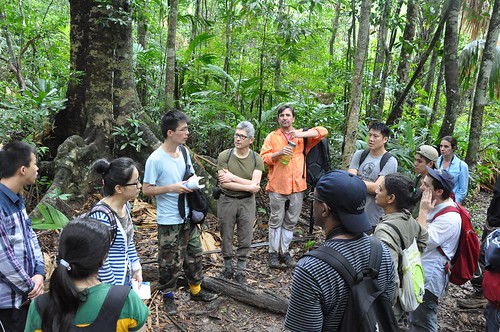
During the second week of the workshop, participants went on a day-long field trip to the 16ha Luquillo field site located in El Yunque National Forest. Jess Zimmerman, the PI of Luquillo, and Aaron Hogan, a PhD student who has research experience in the site, gave in-depth tours of the site and surrounding area. The participants began with an ascent to the Mr. Britton tower for views of El Yunque, followed by a visit to the nearby cloud forest on the El Yunque Trail through palm forest to the Palo Colorado Picnic Area. After lunch, participants departed for El Verde Field Station to walk to the 16ha Luquillo forest site and other research areas.


Jess Zimmerman, PI of Luquillo Forest Dynamics Site, discusses the Mr. Britton Spur at El Yunque National Forest. Photos by Mauro Lepore.

The workshop ended with a full day of scientific presentations where each participant gave a 5-minute lightning talk. All participants shared research findings from the workshop and received feedback and ideas about how to keep their research projects moving forward.


Top left: Mohizah Mohamad; top right: Nestor Engone; bottom left: Daniel Zuleta; bottom right: Pavel Fibich. Photos by David Kenfack.

A final rendezvous at the pavilion at the hotel celebrated the success of the seventh Dimensions of Biodiversity workshop. A big thanks to everyone who participated, and ForestGEO looks forward to hearing about your ongoing research projects and collaborations in the future!

-->

August 22, 2017

Spotlight on: Aaron Hogan’s research in Hainan, China

Aaron Hogan, a PhD student at Florida International University (FIU), recently returned from leading a field campaign at the ForestGEO Jianfengling site in Hainan, China.


Aaron Hogan (left) and Shojun Ling (right) extracting a root sample (photo by Dr. Han Xu: PI of the 60-Ha Jianfengling plot).

At Jianfengling, Hogan studied the relationship between the quantification of root and leaf functional trait plasticity, such as intraspecific variation, and the soil and forest age gradient. Days were spent sampling root and leaf traits, while nights were spent washing, scanning, drying, and weighing root samples. Root functional trait will be related to leaf level traits, specifically focusing on chemical traits as they relate to soil chemistry.

Hogan became interested in studying below ground functional traits about a year ago when he started his PhD work. “Oscar Valverde-Barrantes introduced me to the joy of digging, looking at, and studying tree roots.  The more I got into the literature, the more I realized how little we know about roots and most belowground processes in tropical forests, compared to leaves or aboveground processes,” Hogan said.


A scanned root from a Lithocarpus pseudovestitus Fagaceae (oak family) individual illustrating the root morphology of a dominant species in the Jianfengling forest.

“I think one of the greatest potential findings that may result is the quantification of root and leaf functional trait plasticity (i.e. intraspecific variation) across a soil and forest age gradient. The sampled transect spans two mountain peaks from secondary forest deep into the more primary forest area of Jianfengling, Hainan, which incorporates a substantial amount of environmental variability found in the area,” said Hogan. 

Hogan has been an active collaborator with ForestGEO since 2011, when he volunteered to participate in the tree census at the Luquillo site in Puerto Rico. Hogan will continue his PhD studies at FIU, and ForestGEO looks forward to his future research findings within Jianfengling and other forest sites.

You can read more about J. Aaron Hogan's research on his website and blog here: http://www.jamesaaronhogan.com/.  

List of collaborators:

Smithsonian/ForestGEO

Dr. Hong Liu from (FIU), Dr. Ding Qiong (Hainan University) and Dr. Xu Han (Chinese Academy of Forestry). Field taxonomists from the local forest bureau, including Shaojun Ling, Yaxin Xie, Jaming Wang, Suhui Ma, Siqi Yang, Wenguang Tang, Zhiting Ma, Qiqi Zhang and Jiazhu Shi and Mr. Yu.

-->

--> -->

November 30, 2016

ForestGEO welcomes two new staff members to the team!


ForestGEO is pleased to welcome two staff members to the team this week! The new staff members will be working closely with ForestGEO and the Smithsonian to accomplish administrative tasks for the network in Panama and Washington, D.C. 


Yoselyn Lergier is joining ForestGEO as Administrative Assistant based at the Smithsonian Tropical Research Institute (STRI) in Panama. Yoselyn has three years of administrative experience and has worked as a tour guide and flight attendant, and is fluent in English and Spanish. She is familiar with STRI and has attended many Tupper seminars in the past. Yoselyn will process purchase orders, travel authorizations, and reimbursements, as well as support ForestGEO’s scientific staff, and serve as host for visiting scientists.


Haley Overstreet is returning to ForestGEO as Administrative Assistant based in Washington, DC. She was introduced to the network in Fall 2014 as an undergraduate student in Krista Anderson-Teixeira’s lab collecting and managing data on tree mortality, growth, and phenology at the SCBI ForestGEO plot in Front Royal, VA. She completed her undergraduate degree in Environmental Science and Policy at George Mason University in Fairfax, VA in May 2015. Starting in June 2015, Haley worked as an administrative intern with ForestGEO for one year. Haley will work with Lauren Krizel on developing the new website, ForestGEO’s social media presence, and event planning, among other administrative tasks.  


Please join us in welcoming Yoselyn and Haley to ForestGEO and the Smithsonian!

October 3, 2016

ForestGEO Researchers Receive New Funding to Explore Forest Function

A National Science Foundation grant of nearly $1 million will fund new research at two ForestGEO sites – Harvard Forest and Smithsonian Environmental Research Center (SERC) starting later this year.  The $965,000 award was granted to University of Maryland Associate Professor and ForestGEO partner Nathan Swenson, ForestGEO Director Stuart Davies, and Temperate Forest Program Coordinator Sean McMahon to investigate forest function from genes to canopies. The research aims to quantify how inter- and intra-annual differential gene expression in leaves and genotypic differentiation are related to leaf level gas exchange, fine scale measurements of tree growth, and carbon dioxide flux measured at the scale of forest canopies.


Forests’ ability to absorb and store carbon dioxide makes them integral to regulating climate change. But the thousands of individual trees within a forest vary greatly in their physiological and growth response to environmental change. In order to predict future forest functioning, individual leaf processes need to be linked to larger forest level processes. This research will use innovative new technology and specific measurements of individual tree growth and physiology to address this challenge.  

Harvard Forest, USA
“The work uniquely scales from genes to ecosystems while simultaneously considering spatial and temporal variation in forest function”, said Swenson. “Ecology is entering a exciting new age where the substantial advances made in genome and transcriptome sequencing can now be utilized in non-model organisms in the wild. Coupling these advances in ‘omics with detailed measurements of plant performance from the leaf to the canopy scale was thought to be impossible only a few years ago and it is expected to transform ecology”.

Harvard Forest and SERC are also part of the National Ecological Observatory Network (NEON), which is supported by NSF. It is a network of ecological observation facilities with sites across the U.S. that gathers and analyzes data on climate change, land use change, invasive species, and how these influence biodiversity and natural resources. Goals of NEON include forecasting continental-scale environmental change, informing natural resource decisions, and engaging the next generation of scientists.

August 17, 2016

Dr. Stephen Hubbell wins prestigious International Prize for Biology

CTFS-ForestGEO co-founder Stephen P. Hubbell will receive this year’s International Prize for Biology, awarded by the Japan Society for the Promotion of Science. The committee on the International Prize, chaired by Dr. Takashi Sugimura, announced its selection earlier last week for the specialized field of “Biology of Biodiversity”. The International Prize for Biology is one of the highest scientific honors given by Japan. The prize is granted to Dr. Hubbell for his exceptional contributions to biological and ecological research.

Dr. Hubbell’s long and remarkable career covers a wide-range of research topics including tropical plant ecology, resource competition, animal behavior, and theoretical ecology. He has authored four books and more than 220 scientific papers. He is perhaps most widely known for his unified neutral theory of biodiversity and biogeography that offers a nontraditional explanation for the diversity and relative abundance of species in ecological communities. The theory has spawned a significant growth in research in theoretical ecology.

Currently Dr. Hubbell is a distinguished professor of ecology and evolutionary biology in the Life Sciences Division at University of California, Los Angeles. He is a fellow of the American Academy of Arts and Sciences and of the American Association for the Advance­ment of Science. He is also founding chairman of the National Council for Science and the Environment, an organization whose mission is to improve the scientific basis of environmental decision-making.

In 1980 Dr. Hubbell helped establish the Barro Colorado Island forest plot in Panama, the first of CTFS-ForestGEO’s sites.

August 3, 2016

Workshop fosters cooperation and collaboration for group of global forest ecologists

The Center for Tropical Forest Science - Forest Global Earth Observatory (CTFS-ForestGEO) in partnership with the Chinese Forest Biodiversity Monitoring Network (CForBio) held its annual data analysis workshop this month. The workshop is supported by the National Science Foundation (NSF) through the Dimensions of Biodiversity Program and was hosted by the Chinese Academy of Forestry at the Jianfengling 60ha forest plot on Hainan Island in southeast China. The grant, entitled “Dimensions US-China: Integrating the functional, phylogenetic and genetic components of diversity for improved an understanding of forest change and biodiversity” funds annual workshops for graduate students, postdocs, and senior scientists to gather and collaborate on their research and exchange data and ideas.

The group included 65 participants hailing from 20 countries spanning North and South America, Africa, Europe, and Asia. All participants worked diligently and were pleased with the amount of science and training accomplished during the two week workshop.

Workshop participants in Hainan, China (photo credit: Yao Tze Leong)
Breakout group on demography related to diversity (Yao Tze Leong)
The workshop mission was to bring together a global network of forest researchers to foster research advances and scientific collaborations. This is carried out though an ongoing collaboration between CTFS – ForestGEO and the CForBio with the Chinese Academy of Sciences. Among 51 plots in the CTFS-ForestGEO and CForBio networks, a vast amount of research is being done on how dimensions of biodiversity are changing in forests. Forests everywhere are under threat from deforestation, pollution, invasive species, degradation, and climate and atmospheric change. Understanding and analyzing the data on tree species functional traits, phylogeny, and genetics from the network will inform predictions of forests’ dynamic responses to anthropogenic change.

Sabrina Russo mentors a breakout group (Yao Tze Leong)
Participants worked tirelessly to curate and analyze the immense amount of data pouring out of the global network. The approach centered around small “break out” groups focused on how the dimensions of forest biodiversity regulate the dynamics of tropical forests around the world. Each group received close hands-on mentoring by senior scientists associated with Smithsonian Institute and CTFS-ForestGEO. Participants were guided through the analyses and writing stages of their projects in order to produce manuscripts intended for submission to a peer-reviewed scientific journal.

Erandathi Ekanayake presents findings to her group (Yao Tze Leong)
This intense work schedule was punctuated by lively group meals, happy hours, and lots of joking and cultural exchange. Each day was bookended by lectures from the postdocs and scientists in attendance. Among the notable mentors this year was Steve Hubbell who gave a lecture on forest diversity. A highlight for many participants was the day trip to the Jianfengling 60 ha forest dynamic plot, which is a tropical submontane rainforest notable for its adaptation to seasonal typhoon disturbances. The 65 researchers all trekked the 5 km through bouts of torrential downpours- a proud testament to the fieldwork experience and fortitude possessed by the participants!

Han Xu leads the field trip to the Jianfengling plot (Yao Tze Leong)
Aaron Hogan takes a dbh measurement during the field trip (Yao Tze Leong)
The workshop culminated in an all-day symposium where each participant gave 5-minute lightning talks about their projects and the progress they had made during the workshop. There is no doubt that dozens of CTFS-ForestGEO manuscripts published this year will be largely thanks to the hard work accomplished in Hainan!  

The friendships and connections fostered among participants made the last day bittersweet, but all agreed to prioritize attending the next annual workshop in the USA. 


2016 Workshop in Hainan, China